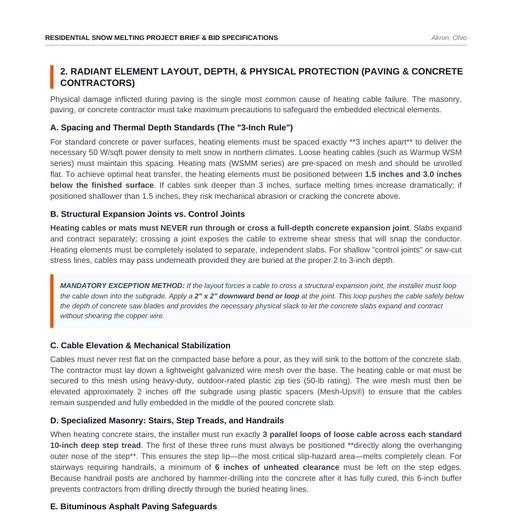
Verdict: 2% slope as a hard minimum, corrected before the pour, not after
An Akron driveway needs a minimum finished surface slope of 2% - a quarter inch of drop per linear foot - to shed meltwater. On a 20-foot run that is 4.8 inches of fall from the house to the street. Anything under 1.5% is a standing-water design: water pools, refreezes, and road salt turns the pooled brine into accelerated surface scaling. Slope is the cheapest thing on the whole project to get right and the most expensive to fix, because fixing it after the pour means tear-out and re-pour.
The slope arithmetic, and where it goes wrong
Slope percentage is rise over run. A 2% grade drops 2 inches per 100 inches of run, which is the same as 1/4 inch per foot. The ACI-recognised absolute bare minimum is 1.0%, and that figure comes with a warning attached: at 1.0% a slightly uneven finish creates birdbaths. The brief's drainage standard is 2.0%, and 3.0% is used where fast drainage matters more than a gentle transition at the apron.
The short version
- The verdict is a minimum finished surface slope of 2%, a quarter inch of drop per linear foot, established before the pour because fixing it afterwards means tear-out and re-pour.
- On a 20-foot run the 2% minimum is 4.8 inches of fall, and anything under 1.5% is a standing-water design in which pooled brine accelerates surface scaling.
- Runoff must be directed away from foundations and pedestrian zones and never discharged onto adjacent unheated pavement, where it pools and refreezes into a hazardous ice sheet.
- A 400 sq ft double driveway carrying 6 inches of wet snow holds roughly 2,000 lb of water once it melts, so it needs a designed path to the street or a permeable base.
- The base is part of the drainage system: 10 inches of compacted aggregate for driveways and 6 for walkways meeting ASTM D 2490, with No. 200 fines limited to 0-8% and geotextile over clay.
- Failure costs run $800 to $1,600 of demolition plus $2,400 to $4,000 of broom-finish paving on 400 sq ft after a failed grade, and $4,000 to $12,000 once a heaving slab is unsupported.
| Run (house to street) | Required drop at 1.0% | Required drop at 2.0% | Required drop at 3.0% | 1/4 in. per foot check |
|---|---|---|---|---|
| 10 ft | 1.2 in. | 2.4 in. | 3.6 in. | 2.5 in. |
| 20 ft | 2.4 in. | 4.8 in. | 7.2 in. | 5.0 in. |
| 30 ft | 3.6 in. | 7.2 in. | 10.8 in. | 7.5 in. |
| 50 ft | 6.0 in. | 12.0 in. | 18.0 in. | 12.5 in. |
Note the discrepancy between the 2.0% column and the quarter-inch rule column. They are the same instruction expressed two ways - 1/4 inch per foot is 2.083% - so a 50-foot run that satisfies the rule needs 12.5 inches, not 12.0. Translating the required drop into something a tape measure can check matters more than the decimal: on a 30-foot run at 2%, the drop is 7-3/16 inches, near enough to 7-1/4. Our drainage slope calculator prints the drop in whole inches and sixteenths for exactly this reason.
Cross-slope, and where the water is allowed to go
Length-wise slope gets water off the driveway; cross-slope keeps it off the house wall and the walkway. The brief's non-negotiable rule is about destination, not gradient: meltwater and storm runoff must be directed completely away from building foundations and pedestrian zones, and must never discharge onto adjacent unheated pavement, where it will pool and refreeze into a hazardous ice sheet. That single sentence rules out the most common Akron grading shortcut - pitching the new driveway at the neighbour's apron or at a section of unheated walkway.
Meltwater volume is easy to underestimate. A 400 sq ft double driveway carrying 6 inches of wet snow holds roughly 2,000 lb of water once it melts. That water needs a designed path to the street or a designed place to infiltrate, and the two answers are a graded swale to a daylight outlet, or a permeable base that takes it vertically.
The base is a drainage system, not just a support layer
Under a heated driveway the aggregate base does double duty: it carries the load and it drains. The Akron brief requires a minimum of 10 inches of compacted aggregate for driveways (6 inches for pedestrian walkways) meeting ASTM D 2490 gradation, with No. 200 fines strictly limited to 0 to 8%. Fines are the enemy. Too much material passing the No. 200 sieve and the base holds water instead of passing it, which means frost heave under a heated slab.
| Sieve size | Percent passing, ASTM D 2490 base | Sieve size | Percent passing, ASTM C33 bedding sand |
|---|---|---|---|
| 2 in. (50 mm) | 100% | 9.5 mm | 100% |
| 1 in. (37.5 mm) | 95-100% | 4.75 mm (No. 4) | 95-100% |
| 3/4 in. (19.0 mm) | 70-92% | 2.36 mm (No. 8) | 85-100% |
| 3/8 in. (9.5 mm) | 50-70% | 1.18 mm (No. 16) | 50-85% |
| No. 4 (4.75 mm) | 35-55% | 0.600 mm (No. 30) | 25-60% |
| No. 200 (0.075 mm) | 0-8% (strict fines limit) | 0.075 mm (No. 200) | 0-1% (wash limit) |
Below the base, the native subgrade is cleared of all organic matter and compacted to at least 98% standard Proctor density under ASTM D 698. Where that subgrade is clay or silty - the common case across Summit County - a geotextile separation fabric goes down before the aggregate. Without it, base stone migrates down into wet soil over time and the slab loses support unevenly.
Permeable pavers: drainage you can calculate
A permeable paver driveway replaces the slab with an open-graded surface over a deliberately deep, open-graded base. That makes it a genuine drainage structure, and it makes the material take-off arithmetic rather than guesswork.
| Material | Rate / density | Calculation | Result per 100 sq ft |
|---|---|---|---|
| Compacted aggregate base, residential driveway | 10 in. depth; 135 lb per cu ft | area x depth/12 x 0.0675 t/cu ft x 1.15 waste | 7.3 tons |
| Same base on weak or expansive clay | +15% base thickness, geotextile mandatory | 11.5 in. depth x same formula | 8.3 tons |
| ASTM C33 bedding sand | 1.0 in. layer; 110 lb per cu ft | area x depth/12 x 0.055 t/cu ft x 1.15 compaction | 0.53 tons |
| ASTM C144 joint sand | 0.0015 tons per sq ft | area x 0.0015 | 0.15 tons |
Two specification traps come with permeable pavers. Bedding sand must conform to ASTM C33; limestone screenings, stone dust and fine quarry sands are prohibited because their No. 200 fines clog the drainage layer and cause winter frost-heaving. And where drainage holes are used at the base of the system, they must be 2 inches in diameter and fully wrapped in geotextile, so water drains while the bedding sand cannot wash out through the holes.
Failure and maintenance truth table for an Akron drainage system
A drainage defect cannot be patched; the remedy is demolition and re-pour. Costs below use this site's 2026 rates - $2.00 to $4.00 per sq ft to demolish a plain slab, $4.00 to $6.00 reinforced, $6.00 to $10.00 per sq ft to replace in broom finish - applied to a 400 sq ft driveway.
| Failure mode | Root cause | First symptom and threshold | Typical interval | Cost to fix | Prevention |
|---|---|---|---|---|---|
| Standing water pools at the apron and low corner | Finished slope under 1.5% - the level at which the brief warns uneven finishing creates birdbaths | Water still on the slab 24 hours after a rain | First freeze-thaw cycle after the pour, then every winter | $800 to $1,600 of demolition plus $2,400 to $4,000 of broom-finish paving on 400 sq ft | Specify 2.0%, show the drop in inches for the actual run length, and verify before the pour |
| Surface scaling and pitting under salt | Pooled brine from de-icing salt refreezing in the low spots | Paste lifting in sheets at the low corner after two or three salt seasons | Years 3 to 8 on a 4 in. slab | Surface replacement at the $2.00 to $4.00 per sq ft plain-slab demolition rate plus finishing | 6% air-entrained mix and a 2% slope so brine leaves the slab instead of sitting on it |
| Frost heave lifts the slab edge | Water held in a base with No. 200 fines above the strict 0-to-8% limit, or no geotextile over clay | A lip at the apron or garage edge that grows each spring | Two to five winters | The $4,000 to $12,000 replacement range once the panel is unsupported | ASTM D 2490 gradation with the fines limit, geotextile over clay or silt, 98% Proctor compaction |
| Base migration and uneven settlement | No separation fabric, so aggregate pumps down into wet subgrade | Deflection under a wheel, or a crack running down the centre of the slab | Years 5 to 10 | Full replacement at $4,000 to $12,000, the same order as a new install | Geotextile before the first lift of stone, and 98% standard Proctor density under ASTM D 698 |
| Permeable joints clog and stop draining | Limestone screenings, stone dust or fine quarry sand substituted for ASTM C33 bedding sand | Joint sand scoured out and water standing over the paver field | Two to four winters | Lift and re-lay the surface at $6.00 to $10.00 per sq ft | ASTM C33 sand at the 0-to-1% wash limit, and 2 in. geotextile-wrapped weep holes |
| Ice sheet on the walkway or the neighbouring apron | Meltwater discharged onto adjacent unheated pavement | Refrozen sheet after the first melt of the season | First storm, then every storm | The re-grade is a demolition job; the ice is a liability | Design and state the discharge destination in writing before the pour |
Two rows carry the money. Runoff pointed at an adjacent unheated apron refreezes within a single storm cycle, and 47 in. of seasonal snowfall supplies plenty of cycles. Base fines above the 0-to-8% limit, or a missing geotextile over clay, lifts the slab edge a fraction of an inch each spring until the panel is unsupported.
Akron and Summit County calibration
The brief is written around 47 in. of seasonal snowfall at a 1-to-3-inches-per-hour melt rate, which is why 2% is a minimum rather than a preference. Clay and silty subgrade, the common Summit County case, triggers the geotextile requirement and the calculator's 15% thicker base. Akron is also the calculator's Midwest baseline cost index, so the $6.00 to $10.00 per sq ft broom rate applies without the +35% Northeast multiplier. Worked example on 400 sq ft at 4 in.: 400 x (4/12) / 27 = 4.94 cu yd, and the standard 10% wastage takes the order to 5.4 cu yd - one 10 cu yd truck, clear of the 4 cu yd threshold where the $150 short-load fee starts. A bid under $5.50 per sq ft - $2,200 here - is the calculator's red alert.
Decision matrix: choose the drainage detail if...
- Choose cast-in-place concrete at 2% on a typical slab with a legal discharge - a graded swale to a daylight outlet, or the street apron.
- Choose permeable pavers if the lot has no lawful place to send the water: no outlet, a neighbouring apron on the low side, or a foundation wall in the fall line.
- Choose the 3.0% slope where the apron meets a street gutter, and never accept anything below 1.5%.
- Choose to fix the grade before pouring if the existing slab pools water 24 hours after rain; re-pouring over a failed grade reproduces it at full price.
Grade and drainage checklist for the bid
- State the finished slope as a percentage and show the drop in inches for the actual run length; 2% minimum, never below 1.5%.
- Confirm the discharge destination in writing: away from foundations and pedestrian zones, never onto adjacent unheated pavement.
- 10 in. compacted aggregate base for driveways at No. 200 fines of 0-8%, over geotextile wherever the subgrade is clay or silty.
- Subgrade compacted to 98% standard Proctor density under ASTM D 698, with organic material removed.
- For permeable pavers: 10 in. base (12 in. for heavy vehicles), 1.0 to 1.5 in. ASTM C33 bedding sand, no limestone screenings or stone dust.
- Any weep or drainage holes 2 in. in diameter and geotextile-wrapped.
Sources
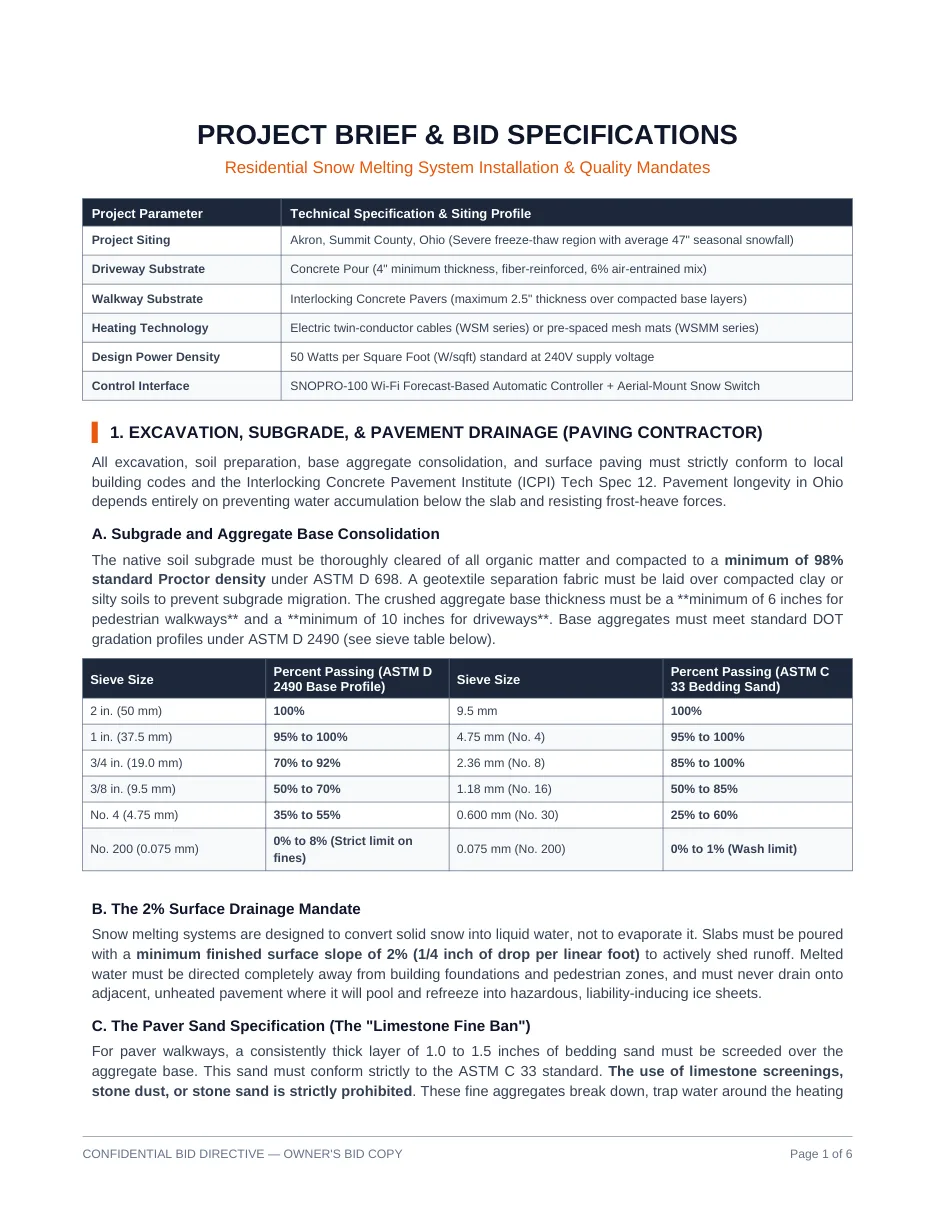
The mandatory 2% finished surface slope (1/4 inch per linear foot), the rule that meltwater must be directed away from foundations and must never drain onto adjacent unheated pavement, the 6-inch and 10-inch compacted base minimums, the ASTM D 2490 sieve profile with the 0-8% fines limit, the ASTM C33 bedding sand profile with its 0-1% wash limit, the 98% standard Proctor density requirement under ASTM D 698, the geotextile requirement over compacted clay or silty soils, and the prohibition on limestone screenings and stone dust are all from the Residential Snow Melting Project Brief & Bid Specifications for Akron, Summit County, Ohio (v2.0) at /media/concrete-driveways/pdfs/heated-driveway-contractor-brief.pdf. The 1.0% absolute minimum and 3.0% fast-drainage slope options, the 1.5% standing-water warning that ties pooling to accelerated freeze-thaw scaling with road salt, the quarter-inch-per-foot comparison, the permeable paver base depths and load classes, the 135 lb/cu ft aggregate and 110 lb/cu ft sand densities, the 1.15 waste and compaction factors, the 0.0015 tons per sq ft joint sand estimate, the clay-soil +15% base multiplier and the 2-inch geotextile-wrapped weep hole specification are the constants in the Concrete Paving & Driveway Calculator Development Prompts behind the drainage and permeable-paver calculators at /akron-concrete-driveways-tools-calculators/. The 2,000 lb meltwater figure for 6 inches of wet snow on 400 sq ft is a planning assumption derived from a 10:1 wet-snow water equivalent, included because the brief requires the runoff destination to be designed but does not state a volume; verify against your own drainage plan.