Verdict: pour in the 50-75°F band, at 4 in. minimum, and wait 28 days for full load
Pour timing on an Akron driveway comes down to three numbers. Temperature first: the curing model behind this site's curing tracker has three bands - mild spring and fall at 50°F to 75°F, hot summer above 75°F, and cold winter below 50°F, where day 7 reaches only 55% of design strength instead of 75%. Thickness second: 4 in. minimum, because a standard 2x4 form is only 3.5 in. wide and pouring flush with the form top shorts the slab. Cure time third: 28 days to 100%, with passenger cars permitted on day 7 only. Plan inside those three numbers and the pour is unremarkable; miss any one and the mistake is permanent. If you are here looking into concrete curing, the sections below walk through the process from the first quote to the finished job.
What each temperature band changes
The weather toggle exists because temperature changes what the mix has to do. Below 50°F hydration slows and every strength milestone shifts; above 75°F the opposite problem appears, because the slab loses moisture during finishing faster than it can cure. The mix chosen alongside the band sets the calendar the driveway lives with - and a standard 3,000 psi ready-mix is the footer mix the curing tracker explicitly does not recommend for driveways.
The short version
- The article's verdict is to pour in the 50-75°F band, at a 4 in. minimum thickness, and wait 28 days for the slab to reach full load capacity.
- In a cold pour below 50°F, day 7 reaches only 55% of design strength instead of 75%, and day 14 reaches 80% instead of 90%, which is why a high-early-strength mix is specified.
- A standard 2x4 form is only 3.5 in. wide, so pouring flush with the form top leaves the slab half an inch thinner than the spec across the whole pour.
- Traffic zones are strictly graded: foot traffic only on days 1-3, pedestrian safe with passenger cars on day 7, light vehicles on day 14, and full load including RVs at day 28.
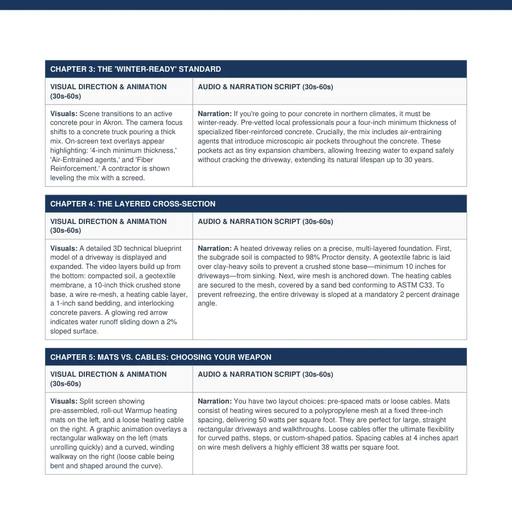
- The specified mix is 4,500 psi air-entrained exterior winter concrete with 6% air entrainment, against a standard 3,000 psi mix that cracks and spalls within 10 to 15 years in Ohio frost.
- Tear-out and re-pour on a 400 sq ft driveway runs $3,200 to $5,600, and the article flags any quote below $5.50 per sq ft as unable to fund both a compacted aggregate base and steel reinforcement.
| Band | Range | Day 7 strength | What must change on site |
|---|---|---|---|
| Mild spring / fall | 50°F to 75°F | 75% of ultimate | The reference case: Type I mix, wet cover or curing compound, blankets not required |
| Hot summer | above 75°F | Ahead of the mild curve | Moisture loss during finishing is the risk: cure sooner and keep the surface wet |
| Cold winter | below 50°F | 55% of ultimate - and 80% at day 14 instead of 90% | Curing blankets stay on longer, or specify high-early-strength concrete (70% at day 3, 90% at day 7) |
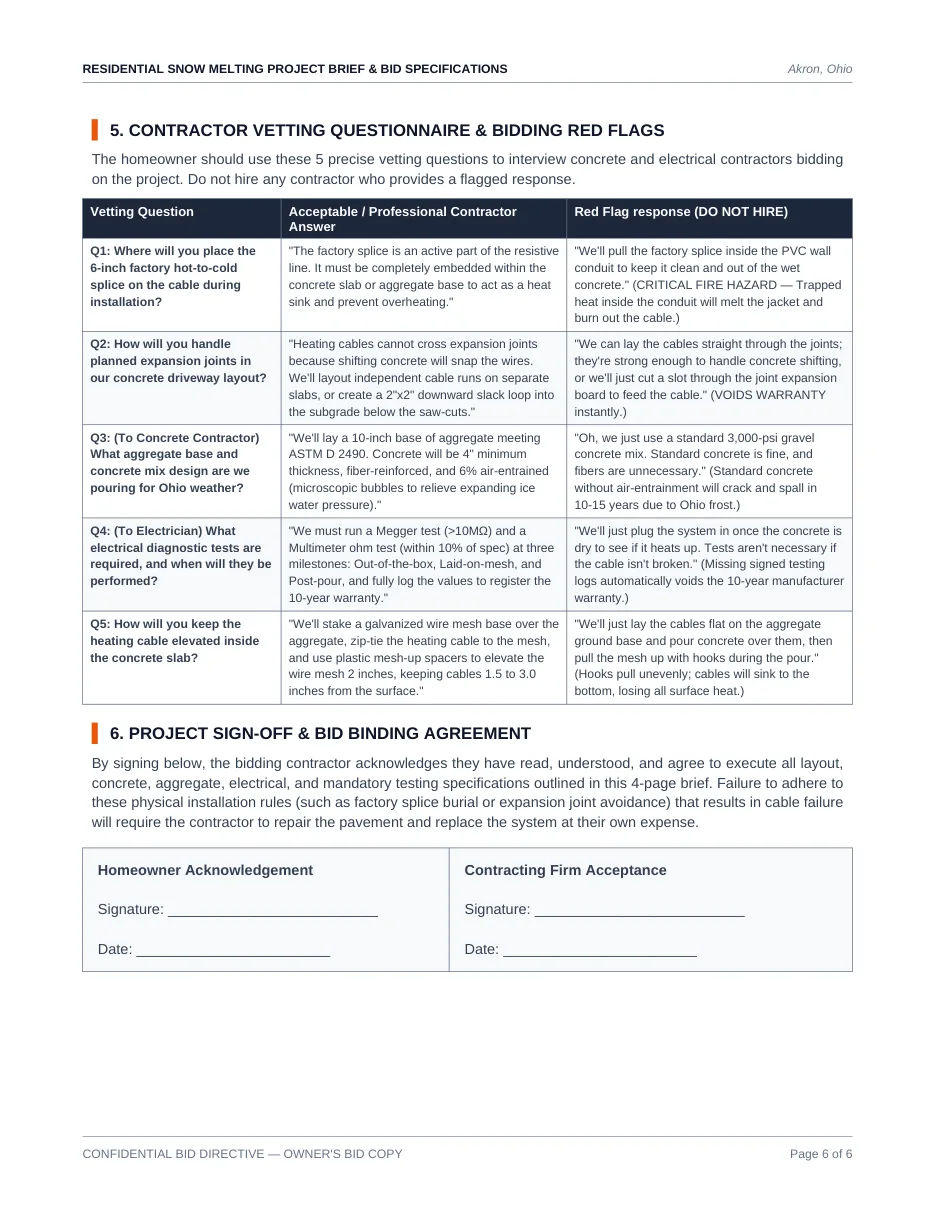
Two of those rows are decisions nobody can undo later. A 3,000 psi mix without air entrainment is the mix the vetting sheet in the Akron snow-melting brief calls out as cracking and spalling in 10 to 15 years in Ohio, and air entrainment is the only ingredient that gives freezing water somewhere to expand - water grows about 9% as it freezes, and that is the force that fractures the pore structure. The 4,500 psi air-entrained exterior winter mix is what an Akron driveway should be poured in.
The hydration calendar, and when the driveway can take a load
Concrete does not reach strength at the pour; it reaches it over 28 days. The percentages and traffic zones below are what the site's curing tracker models, and they are the difference between a slab that lasts 30 years and one that cracks in its first season.
| Age | Mild 50-75°F | Cold below 50°F | High-early mix | Allowed on the slab |
|---|---|---|---|---|
| Day 1 | 20% | 15% | 40% | Foot traffic only; keep curing blankets wet |
| Day 3 | 45% | 30% | 70% | Foot traffic only; protect from bikes, pets and children |
| Day 7 | 75% | 55% | 90% | Pedestrian safe; passenger cars on day 7 only |
| Day 14 | 90% | 80% | 98% | Light vehicles: sedans, small SUVs, pickups |
| Day 28 | 100% | 100% | 100% | Fully cured and safe for RVs, trailers and equipment |
Read the cold column against the mild one and the scheduling cost of an autumn pour is obvious: at day 7 a cold-weather slab carries the strength a mild-weather slab had at around day 4. Days 8 to 27 are the quiet danger zone - light vehicles are fine, but heavy equipment, delivery vans and mixer trucks are not, and the person most likely to drive a loaded truck onto a three-week-old slab is the contractor doing the next stage of the job.
The pour mistakes that end in demolition
Four of the six rows below are decided in the hour before the truck arrives and cost almost nothing to prevent; the other two are decided by what happens in the two weeks after it leaves.
| Failure mode | Root cause | First symptom and threshold | Typical interval | Cost to fix | Prevention |
|---|---|---|---|---|---|
| Cracking and spalling under freeze-thaw | A standard 3,000 psi gravel mix with no air entrainment | Surface paste lifting in sheets after two or three salt seasons | Cracks and spalls in 10 to 15 years in Ohio | Tear-out and re-pour: $2.00 to $4.00 per sq ft of demolition plus $6.00 to $10.00 per sq ft of new broom finish | 4,500 psi air-entrained exterior winter mix specified in writing |
| A slab 0.5 in. thinner than the form implies | Pouring flush with the top of a 2x4 form, which is 3.5 in. wide and not 4.0 in. | The order is short by 0.5 in. of depth across the whole slab; edge chipping under load follows | From the first heavy vehicle | 0.62 cu yd of missing concrete on 400 sq ft, and a permanently understrength slab | Excavate 0.5 in. below the form bottom, or use true 4 in. forms and verify depth |
| Surface dusting and a weak top | No curing compound or wet cover - or the mild-weather schedule applied to a sub-50°F pour | Day 7 strength at 55% of ultimate instead of 75% | First abrasive season | Surface only at first, then scaling into the spalling row above | A curing plan keyed to the actual pour temperature, with day 7 and day 28 access limits |
| Cracks from loading too early | Passenger cars before day 7, or a loaded van inside the day 8-27 window | Hairline cracks down the centre of the slab | Within days of the load | Permanent; sealed rather than repaired, because the strength is never recovered | Enforce the day 1-3, 4-7, 8-27 and 28+ traffic zones with the crew and the family |
| Short load and a $150 surprise | Ordering under 4 cu yd, or ignoring the wastage factor | The plant adds the short-load fee; the placement stalls mid-slab | At the pour | $150 plus the cost of a cold joint, which is the real damage | Order base volume plus the 10% wastage factor, rounded up to the nearest quarter yard |
| Slab edge lifted at the apron | No geotextile over clay, or aggregate above the 0-to-8% No. 200 fines limit | A lip at the apron or garage edge that grows each spring | Two to five winters | The $4,000 to $12,000 replacement range once the panel is unsupported | Geotextile over clay, ASTM D 2490 base gradation, 98% standard Proctor compaction |
The cost column is what makes the point. On the 400 sq ft driveway used throughout this article the tear-out and re-pour runs $3,200 to $5,600 - $800 to $1,600 of demolition plus $2,400 to $4,000 of new broom finish - against a few dollars per cubic yard between the 3,000 psi mix and the 4,500 psi air-entrained mix. Nobody saves money pouring the cheaper mix; they defer the invoice to a year when the driveway is also holding a car.
Ordering concrete, and what the pour costs in Akron
Volume is the easiest thing on the job to get wrong and the only one the plant prices instantly. A ready-mix truck carries a maximum of 10 cu yd, the standard wastage factor for spillage and uneven ground is 10%, and a short-load fee averaging $150 applies below 4 cu yd. Worked example on a 20 x 20 ft driveway at the 4 in. minimum depth: 400 x (4/12) / 27 = 4.94 cu yd, which the wastage factor takes to 5.4 cu yd - one truck, clear of the short-load threshold.
| Line | 2026 rate or constant | Figure on a 400 sq ft driveway |
|---|---|---|
| Concrete volume at 4 in. | area x depth / 27 | 4.94 cu yd before wastage |
| Order with standard wastage | x 1.10, rounded up to the nearest quarter yard | 5.4 cu yd - one 10 cu yd truck |
| Standard broom finish | $6.00 to $10.00 per sq ft | $2,400 to $4,000 |
| Demolition, plain unreinforced slab | $2.00 to $4.00 per sq ft | $800 to $1,600 |
| Demolition, rebar-reinforced slab | $4.00 to $6.00 per sq ft | $1,600 to $2,400 |
| Short-load fee | $150 below 4 cu yd | not charged at 5.4 cu yd |
| Cheap-bid trap flag | below $5.50 per sq ft | $2,200 - the red-alert line for this slab |
Akron sits at the calculator's Midwest baseline cost index, so these published rates apply to this market as written; the +35% regional multiplier is a Northeast-market adjustment and does not belong in an Akron bid. The cheap-bid flag is the line to keep: under $5.50 per sq ft the quote cannot fund a compacted aggregate base and steel reinforcement at the same time, and the rest of the job is what gets skipped.
Akron and Summit County calibration
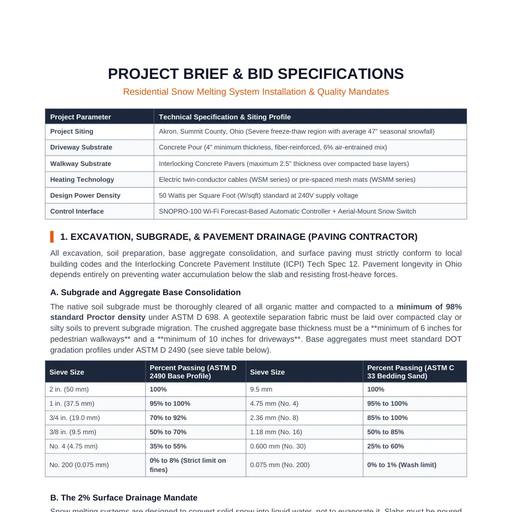
Three local conditions set the pour window here. Snowfall first: the Akron brief is written around 47 in. of seasonal snowfall, and the freeze-thaw cycling that comes with it is why the 4 in. thickness, the 6% air-entrained mix and the 10 in. compacted base are specified together rather than as options. Subgrade second: clay and silty soils, the common case in Summit County, require a geotextile separation layer over the compacted subgrade and a 15% thicker base in the calculator, or the slab loses support unevenly as the clay moves. Drainage third: a minimum 2% finished slope is mandatory - on a 20 ft run that is 4.8 in. of fall from the apron to the street. Temperature is the seasonal clock: a pour below 50°F reaches only 55% of strength at day 7, so an October or November pour in this market needs curing blankets, a high-early mix, or a move to spring.
Decision matrix: choose the pour window if...
- Choose a late-spring or early-fall date if you want the reference case - mild 50-75°F curing, day 7 at 75%, day 14 at 90%, and no blankets.
- Choose high-early-strength concrete if the pour has to land below 50°F: day 3 reaches 70% and day 7 reaches 90%, which pulls the passenger-car date back toward the mild-weather schedule.
- Choose to move the date if rain is forecast while heating cable or mesh is already pinned to the base - saturated bedding sand cannot be compacted, and digging it out is an extra day of labour.
- Choose a 4 in. minimum slab with 6% air entrainment whatever the date, because the mix, not the calendar, is what survives the next 30 winters.
- Choose to reject the quote if it carries no written mix design, no curing plan, or a per-square-foot number under $5.50.
Pour-day spec handoff checklist
- Mix in writing: 4,500 psi exterior winter mix with 6% air entrainment, 4 in. minimum thickness, fiber-reinforced.
- Base: 10 in. compacted aggregate to the ASTM D 2490 gradation, No. 200 fines limited to 0 to 8%, geotextile over clay or silt.
- Subgrade compacted to 98% standard Proctor density under ASTM D 698, with all organic matter removed.
- Drainage: minimum 2% finished slope, with the discharge destination named in the contract.
- Volume: order base volume plus 10% wastage, confirm the truck count, and check the 4 cu yd short-load threshold.
- Curing plan keyed to the forecast pour temperature, including the day 1-3, 4-7, 8-27 and 28+ access rules.
- Timing: no pour against a rain forecast once elements or mesh are pinned to the base.
Sources
The ambient temperature bands (mild 50-75°F, hot above 75°F, cold below 50°F), the three mix options (standard 3,000 psi ready-mix, exterior winter mix at 4,500 psi air-entrained, and high-early-strength), the hydration curve (20/45/75/90/100% at days 1, 3, 7, 14 and 28), the cold-weather curve (15/30/55/80% to day 14), the high-early curve (40/70/90/98%), and the day 1-3, 4-7, 8-27 and 28+ traffic-access zones are the constants behind the curing tracker at /akron-concrete-driveways-tools-calculators/. The 2x4 form shortfall (a 2x4 is 3.5 in., not 4.0 in.), the 10 cu yd maximum truck load, the $150 short-load fee below 4 cu yd, the 5% / 10% / 15% wastage options, the 2026 finish and demolition rates (broom $6.00 to $10.00 per sq ft, plain slab demolition $2.00 to $4.00, reinforced demolition $4.00 to $6.00), the $5.50 per sq ft cheap-bid flag, the regional cost index in which this market sits at the Midwest baseline, and the minimum 1.0% / recommended 2.0% / fast 3.0% slope standards are from the Concrete Paving & Driveway Calculator Development Prompts behind the cost, volume and drainage calculators on the same page. The 4 in. minimum thickness, 6% air-entrained fiber-reinforced mix, 10 in. compacted base, ASTM D 2490 gradation with the 0-to-8% fines limit, geotextile over clay or silty soils, 98% standard Proctor compaction under ASTM D 698, the mandatory 2% surface drainage slope and the prohibition on discharging runoff onto adjacent unheated pavement are from the Residential Snow Melting Project Brief & Bid Specifications at /media/concrete-driveways/pdfs/heated-driveway-contractor-brief.pdf; the 10-to-15-year failure window for a non-air-entrained mix under Ohio frost comes from the same brief's contractor vetting questionnaire. The 9% freeze expansion of water, the corrosive-brine effect of rock salt and the 30-year service life of a winter-ready air-entrained mix come from the Anatomy of a Heated Driveway production script at /media/concrete-driveways/slides/.