Verdict: electric cable for almost every Akron driveway, hydronic only above roughly 1,000 heated square feet
An electric snow-melt system on a standard two-car Akron driveway draws 4 kW to 20 kW depending on how much of the slab you heat, runs at roughly $0.64 to $3.20 an hour at 16¢/kWh, and needs no annual servicing. A hydronic system circulates a heated glycol-water mix through PEX tubing from a boiler; it costs more up front, adds $150 to $400 a year in maintenance, and only wins on very large or very long driveways where cheap natural gas or propane beats electric resistance heat. For a 400 sq ft Summit County driveway, the electric tire-track layout is the cheaper system to own on both install and service.
How each system actually works under the slab
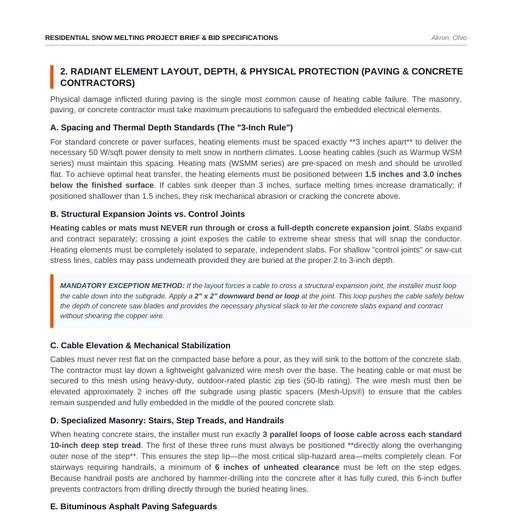
Both technologies do the same physical job: convert solid snow to liquid water and keep the slab above 32°F so meltwater cannot refreeze into a sheet of ice. The Akron bid specification permits exactly two element types in concrete: electric twin-conductor heating cables in a WSM-series loose format, or pre-spaced WSMM mesh mats. Both are designed to deliver 50 watts per square foot of heated area at 240 V, buried 1.5 to 3.0 inches below the finished surface.
The short version
- The verdict is electric cable for almost every Akron driveway, with hydronic glycol systems justified only above roughly 1,000 heated square feet.
- An electric system on a standard two-car driveway draws 4 kW to 20 kW depending on heated area and runs at about $0.64 to $3.20 an hour at 16 cents per kWh, with no annual servicing.
- A hydronic system circulates heated glycol-water through PEX tubing from a boiler, costs more up front, and adds $150 to $400 a year in maintenance.
- Tire tracks over 80 sq ft cut heated area by 80% on a 20 x 20 ft slab, dropping the seasonal bill to $57.60 against $288 for 400 sq ft of full coverage.
- Electric cable is rated 30 to 50 years against 20 to 30 years for PEX and 15 to 20 for a boiler, and over 30 years maintenance on a 400 sq ft driveway is $0 versus $4,500 to $12,000.
- Failures inside the slab require demolition over the fault, priced from the $4,000 to $12,000 replacement range, and the 6-inch factory hot-to-cold splice must be embedded because pulling it into conduit makes it overheat and burn out in minutes.
A hydronic system replaces the resistance cable with a boiler, a pump, a manifold, and flexible PEX tubing carrying a glycol-water mix. Nothing about that is exotic, but it adds moving parts and fluid to a slab that has to survive Akron's freeze-thaw cycles.
| Element | Electric cable / mat (WSM, WSMM) | Hydronic PEX |
|---|---|---|
| What is buried | Twin-conductor resistance cable, 3 in. spacing, zip-tied to galvanised wire mesh | PEX tubing loops carrying glycol-water, plus a boiler, pump and manifold |
| Design output | 50 W/sq ft at 240 V (38 W/sq ft if loose cable is laid at 4 in. spacing) | Boiler output sized in BTU/hr; supply temperature set by outdoor reset |
| Controls | SNOPRO-100 Wi-Fi forecast controller + aerial snow switch + in-slab limit sensor | Outdoor sensor, boiler aquastat, zone valves and pumps |
| Electrical/mechanical scope | Dedicated GFEP double-pole breakers, 40 A max continuous per branch circuit | Gas or propane supply, flue, pump wiring, glycol fill and purge |
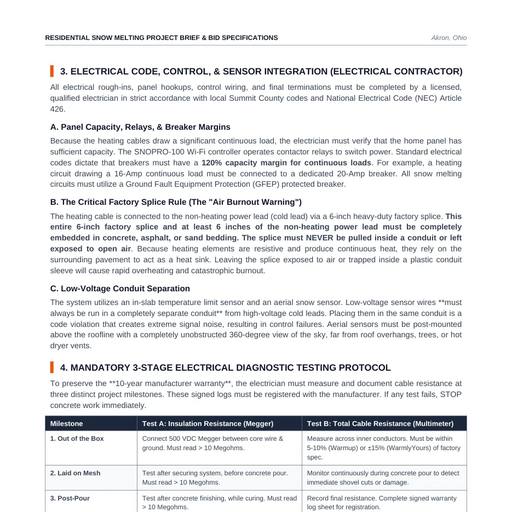
Because electric elements are resistive and produce heat continuously, they depend on the surrounding pavement as a heat sink. That single property drives the most expensive installation error in the trade: the 6-inch factory hot-to-cold splice must be fully embedded in concrete, asphalt or sand bedding. Pull it inside a conduit to "keep it clean" and it overheats and burns out in minutes. A hydronic system has no splice to bury, but it does have a boiler to flue and a fluid loop to leak.
What each system costs to run in an Akron winter
Every figure below uses the constants built into this site's own heated-driveway calculator: 50 W/sq ft, 240 V supply, 16¢/kWh, the regional average 6-hour storm plus the recommended 3-hour after-run that evaporates residual meltwater, and 10 plowable storms per season. The electric numbers are exact arithmetic, not estimates.
| Layout | Heated area | Draw | Per hour | Per 6 h storm + 3 h after-run | Season (10 storms) |
|---|---|---|---|---|---|
| 20 x 20 ft full coverage | 400 sq ft | 20 kW | $3.20 | $28.80 | $288.00 |
| 20 x 20 ft tire tracks | 80 sq ft | 4 kW | $0.64 | $5.76 | $57.60 |
| 30 x 20 ft full coverage | 600 sq ft | 30 kW | $4.80 | $43.20 | $432.00 |
| 10 x 20 ft walkway approach | 200 sq ft | 10 kW | $1.60 | $14.40 | $144.00 |
Tire tracks are two parallel 2-foot-wide paths where the tyres actually travel. They cut heated area by 80% on a 20 x 20 ft slab and cut both the element cost and the seasonal bill by the same proportion. The trade-off is honest and worth stating plainly: only the tyre paths clear. If you want the whole apron dry, buy the 20 kW system and expect the panel consequences covered in our electrical load article.
Hydronic running costs are genuinely lower per hour because a boiler burning natural gas delivers heat far cheaper than electric resistance. The crossover is size, not preference. A 4 kW electric tire-track system consumes about 640 kWh in a full 10-storm season; a hydronic loop serving the same 80 sq ft still carries a boiler, a pump and glycol maintenance, so the per-hour saving never recovers the added capital and service cost at that scale.
Maintenance, lifespan and repair: the numbers owners never get quoted
| Metric | Electric | Hydronic |
|---|---|---|
| Annual maintenance | $0 - no scheduled servicing | $150-$400/yr: boiler service, pump checks, glycol pH testing |
| Element lifespan | Cables rated 30-50 years, outlasting the pavement | PEX 20-30 years; boiler 15-20 years |
| Failure mode | Single cable break, located with thermal imaging and signal-travel testing, then spliced | Pressurised fluid leak under a cured slab |
| Concrete requirement | 4 in. min., fiber-reinforced, 6% air-entrained, 10 in. compacted base | Same slab spec; plus boiler flue and gas line |
| Warranty condition | Signed 3-stage test log (out-of-box, laid-on-mesh, post-pour) registers the 10-year cable warranty | Manufacturer boiler and tubing warranties, service records |
The boiler is the tell. A hydronic system replaces one part with three - boiler, pump, manifold - and adds a fluid that has to be chemically monitored. On a 47-inch snowfall winter like Akron's, when both systems are asked to melt 1 to 3 inches of snow per hour and then hold the surface dry through a 3-hour after-run, the electric system simply has fewer things that can break.
Failure and maintenance truth table: electric against hydronic
Read this table by counting parts. The electric column has one component that can fail inside the slab and no moving parts anywhere else; the hydronic column carries a boiler, a pump, a manifold and a fluid, and three of those four arrive with a service interval.
| Failure mode | Electric cable (WSM / WSMM) | Hydronic loop (PEX / boiler) | Typical interval | Cost to fix |
|---|---|---|---|---|
| Failure inside the slab | The 6 in. factory hot-to-cold splice pulled into conduit overheats and burns out in minutes; a sunken run loses surface heat | PEX kinked or crushed during the pour; a loop air-locks at the manifold | Electric: from commissioning if installed wrong. PEX: 20 to 30 years | Both mean demolition over the fault, priced from the $4,000 to $12,000 replacement range |
| Moving-part failure | None - resistive cable has no moving parts | Boiler, circulator pump, expansion tank and manifold | Boiler at 15 to 20 years; pump sooner | Boiler and pump replacement, on top of the $150 to $400 annual service band |
| Routine annual service | $0 a year; no fluid, no filter, no contract | $150 to $400 a year in glycol, pump and burner service | Every year of service | Over 30 years that is $0 against $4,500 to $12,000 on a 400 sq ft driveway |
| Design life of the buried element | Cable rated 30 to 50 years | PEX rated 20 to 30 years; boiler 15 to 20 years | At end of life | Hydronic replacement opens the pavement again, because PEX does not outlive the slab |
| Energy waste from control strategy | Manual timer instead of forecast sensing wastes up to 70% of the energy the deck measures | Outdoor reset sensor failure leaves the boiler running cold or overheating the loop | First season if mis-installed | Retrofit and remount labour; the mechanical cost is identical either way |
| Warranty survival | The 10-year manufacturer warranty is void without the three-stage 500 VDC Megger log above 10 megohms | Boiler warranty is conditional on annual service records | At the first claim | A denied claim moves the entire repair onto the homeowner |
The annual column is where the choice is actually made: $0 a year against $150 to $400, compounded across a 30-to-50-year cable life versus a 20-to-30-year PEX life and a 15-to-20-year boiler. A gas boiler's per-hour fuel saving is real, but on a 4 kW tire-track layout it never repays the added capital and the glycol. Both columns share the risk no equipment choice removes: pour the wrong mix or fail the grade and the repair means demolishing a heated slab, so the system you bury matters less than the slab you bury it in.
Akron and Summit County calibration
Local inputs sit on the calculator's own defaults, which keeps the comparison clean. The design profile is 47 in. of seasonal snowfall at a 1-to-3-inches-per-hour melt rate, and the season is 10 storms modelled as a 6-hour event plus the prescribed 3-hour after-run at 16¢/kWh: 640 kWh and $57.60 through a 4 kW tire-track system, $288 through 20 kW of full coverage. Akron is also the calculator's Midwest baseline cost index, so the $6.00 to $10.00 per sq ft broom rate and the $8 to $25 per sq ft heated-installation range apply without the +35% regional multiplier. The clay subgrade that mandates geotextile separation and a 15% thicker base lands on the concrete side of the ledger whichever heat source you pick.
Choose electric if, choose hydronic if
- Choose electric if your driveway is a typical 2-car slab under 700 sq ft, if gas is not already run to the garage, if you want no annual service contract, or if you are heating tire tracks rather than the whole apron.
- Choose hydronic if heated area exceeds roughly 1,000 sq ft, if the driveway is long and narrow with a large heated footprint, or if a gas boiler already exists on the property and the added boiler capacity is incremental rather than new.
- Choose neither yet if you are pouring a standard 3,000 psi gravel mix. Standard concrete without air entrainment cracks and spalls in 10 to 15 years in Ohio, which means you would be embedding heating cable in a slab that fails before the cable does.
Spec handoff: put these six lines in the bid
- Element type and spacing: WSM-series cable or WSMM mats at 3 in. spacing, 50 W/sq ft of heated area, 240 V.
- Depth: elements 1.5 to 3.0 inches below the finished surface, suspended on galvanised wire mesh, elevated about 2 in. off the subgrade on plastic spacers.
- Slab: 4 in. minimum, fiber-reinforced, 6% air-entrained, over a 10 in. compacted base at 98% standard Proctor density (ASTM D 698) with geotextile over clay.
- Joints: no cable crosses a full-depth expansion joint; if it must, a 2 in. x 2 in. downward slack loop into the subgrade.
- Controls: forecast-based Wi-Fi controller with an aerial snow switch and an in-slab limit sensor, low-voltage sensor wiring in its own conduit.
- Testing: 500 VDC Megger reading above 10 Megohms plus an ohm reading within the manufacturer tolerance at all three milestones, logged and signed.

Sources
Figures in this article come from four named sources. The engineering spec - 50 W/sq ft at 240 V, WSM/WSMM elements, 1.5 to 3.0 in. depth, 6% air entrainment, the 10 in. base, the splice rule, GFEP and 120% continuous-load margins - is from the Residential Snow Melting Project Brief & Bid Specifications, Akron, Summit County, Ohio, v2.0 August 2026, published in full at /media/concrete-driveways/pdfs/heated-driveway-contractor-brief.pdf. The 1-to-3-inches-per-hour melt rate, 47 in. seasonal snowfall and Akron siting come from the same brief; the layered cross-section and the 9% freeze expansion come from the Anatomy of a Heated Driveway production script at /media/concrete-driveways/slides/. Energy costs were computed from the constants in the Concrete Paving & Driveway Calculator Development Prompts (50 W/sq ft, 16¢/kWh default, 6-hour storm plus 3-hour after-run, 10 storms/season) that drive the calculator at /akron-concrete-driveways-tools-calculators/, and the maintenance, lifespan and repair lines come from the Akron concrete notebook's Modern Driveway Blueprint and Concrete Quiz content blueprints.