Verdict: 4-inch fiber-reinforced, 6% air-entrained concrete over a 10-inch base, or do not bother embedding cable in it
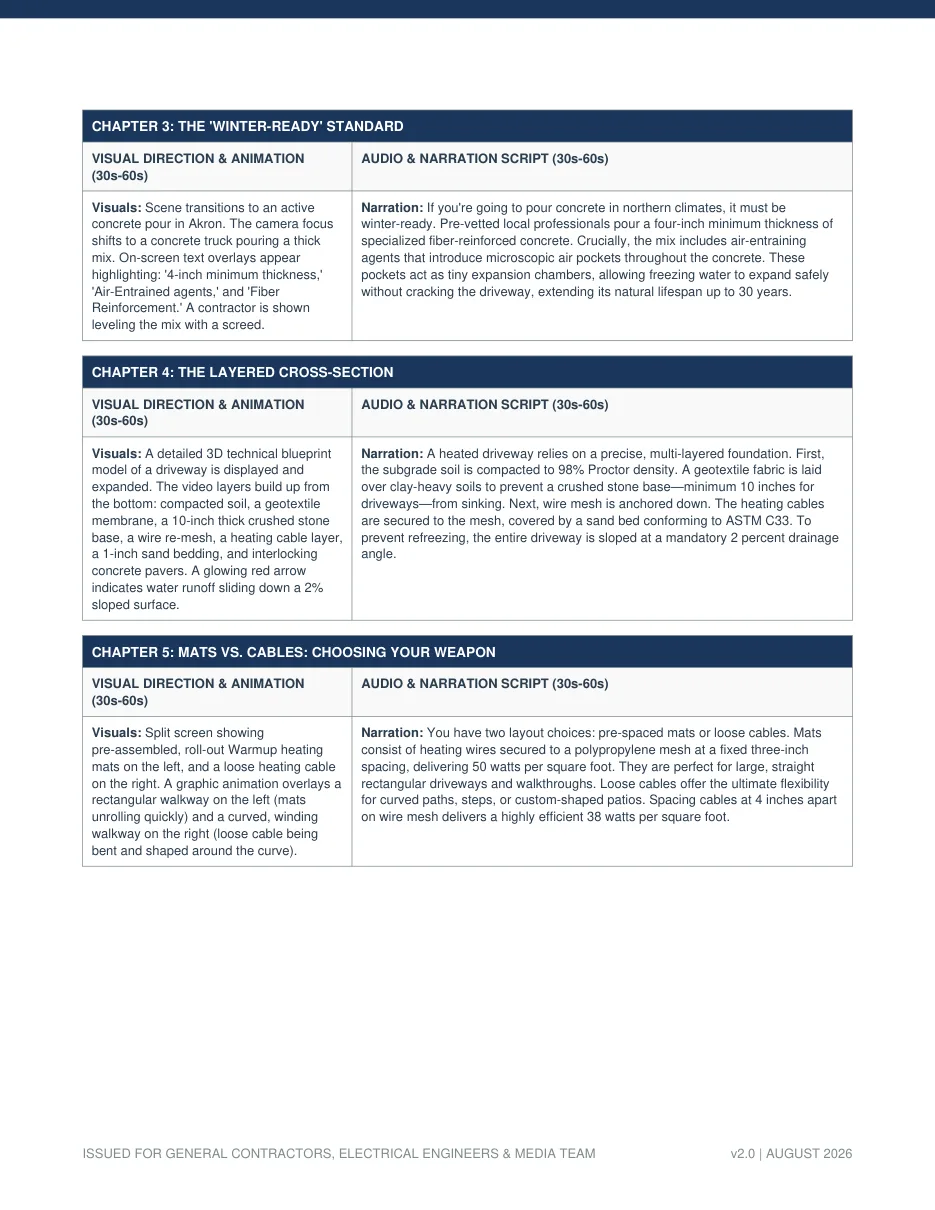
A heated slab is only as good as the concrete around the cable. The Akron bid specification calls for a 4-inch minimum pour, fibre-reinforced, with a 6% air-entrained mix. A standard 3,000 psi gravel mix without air entrainment cracks and spalls in 10 to 15 years in Ohio - which means it would fail at roughly the same time as the unheated driveway you were trying to avoid replacing, and it would take 30-to-50-year heating cable down with it when it does. The mix is not a contractor preference. It is the difference between a 10-year slab and a 30-year one.
Air entrainment: the one additive that decides the outcome
Concrete is porous. Water seeps into those pores, and when it freezes it expands by about 9%, fracturing the matrix from the inside. Repeat that through an Akron winter of freeze-thaw cycles and you get progressive cracking, pitting and spalling. Road salt makes it worse: it melts ice temporarily while creating a highly corrosive brine that accelerates deep pitting and surface scaling.
The short version
- The verdict is a 4-inch minimum fiber-reinforced, 6% air-entrained pour over a 10-inch base, because a heated slab is only as good as the concrete around the cable.
- A standard 3,000 psi gravel mix without air entrainment cracks and spalls in 10 to 15 years in Ohio and would take 30-to-50-year heating cable down with it.
- Water expands about 9% when it freezes and fractures the concrete matrix, while air-entraining agents create microscopic pockets that give the expanding ice somewhere to push, lifting service life to up to 30 years.
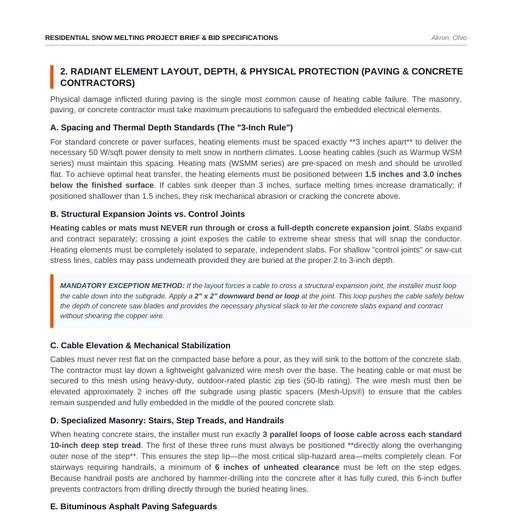
- Heating cable must never cross a full-depth expansion joint; where a crossing is unavoidable the spec requires a 2 in. x 2 in. slack loop into the subgrade, and a slot cut through the expansion board voids the 10-year warranty.
- Welded wire mesh is the armature the cable is zip-tied to and must be elevated about 2 in. on spacers, because finishers walking the mesh to the base sinks the cable and causes a 6 to 12 in. cold stripe.
- Cold pours below 50°F reach only 55% of design strength at day 7 instead of 75% and 80% at day 14 instead of 90%, which is the case for using a high-early-strength mix that hits 70% at day 3.
Air-entraining agents introduce microscopic air pockets throughout the mix. Those pockets give expanding ice somewhere to push instead of cracking the surrounding concrete. The Akron brief specifies a 6% air-entrained mix; combined with fiber reinforcement, the documented effect is a service life extending up to 30 years in a climate where a standard slab lasts 10 to 15.
| Mix / detail | Service life in a harsh northern winter | Verdict for a heated driveway |
|---|---|---|
| Standard 3,000 psi gravel mix, no air entrainment | 10-15 years before cracking and spalling | Reject. The slab fails before the cable does |
| 4,500 psi exterior winter mix, air-entrained | The brief's baseline for outdoor slabs in Ohio frost | Minimum acceptable |
| 4 in. min., fiber-reinforced, 6% air-entrained | Up to 30 years | The specified build for embedded cable |
| High-early-strength mix (chemical accelerators) | Reaches 70% of design strength at day 3 instead of 45% | Only to shorten cold-weather access restrictions |
Fibre versus rebar versus welded wire mesh
The brief specifies fibre reinforcement in the mix. Reinforcement for a heated slab has three jobs, and only the first is structural: carry vehicle loads, hold the concrete together after it cracks, and - specific to a heated driveway - hold the cable at the correct depth while the pour is placed and finished. That third job is why both systems are used together: fibres in the mix plus galvanised welded wire mesh shallow enough to tie the cable to.
| Reinforcement | Unit weight / coverage | Typical spacing | Role on a heated slab |
|---|---|---|---|
| Fibres in the mix | Specified as part of the 4 in. winter mix | n/a | Crack-width control through freeze-thaw cycling |
| #4 rebar (1/2 in.) | 0.668 lb per linear foot | 12 in. heavy load / 16 in. residential | Load carrying; must be positioned clear of the heating elements |
| #3 rebar (3/8 in.) | 0.376 lb per linear foot | 16 in. standard / 18 in. light | Light residential grid |
| Welded wire mesh, 6x6 | 5 x 10 ft sheet = 50 sq ft, about 15 lb per sheet; order count x 1.15 for laps | Sheets butted with overlap | The layer the heating cable is zip-tied to; useless if trodden to the base |
Welded wire mesh earns its place in a heated slab for a reason that has nothing to do with bending strength: it is the armature the cable is tied to, and it must be elevated roughly 2 inches off the subgrade on plastic spacers so the cable ends up in the middle of the pour. If finishers walk the mesh down to the aggregate during a pour, the cable sinks with it - surface heat is lost and mesh structural value is zero. Ask any Akron contractor how they elevate the mesh, and treat "we'll pull it up with hooks during the pour" as a disqualifying answer.
Joints: the rule that protects the cable, and the one that voids the warranty
Heating cable must never run through or cross a full-depth expansion joint. Slabs move independently; a cable spanning that gap takes the full shear and eventually snaps. Two compliant approaches exist. The preferred method is to pre-mark every planned expansion joint on the compacted base and design each slab with its own independent run that stops clear of the joint. Where the layout forces a crossing, the brief mandates a 2 in. x 2 in. downward bend or loop of cable into the subgrade: the loop sits below the reach of a concrete saw blade and provides slack for slab movement.
Shallow control joints - saw-cut stress lines - are different. Cable may pass underneath a control joint provided it is buried at the proper 2 to 3 inch depth, below the blade. A contractor who proposes cutting a slot through the expansion board to feed cable through has voided the 10-year manufacturer warranty in writing.
Curing decides whether the mix you paid for is the mix you get
Strength is developed over time, not at the pour. The site's own curing tracker models the standard hydration curve and the traffic restrictions that go with it. Skipping the curing compound or the wet-cover period is not a scheduling shortcut; it is a permanent loss of surface strength and abrasion resistance on a slab you intend to salt and shovel for three decades.
| Window | Standard mix (50-75°F) | Cold pour (below 50°F) | High-early mix | Access allowed |
|---|---|---|---|---|
| Day 1 | 20% | 15% | 40% | Foot traffic only; keep blankets wet |
| Day 3 | 45% | 30% | 70% | Pedestrian safe |
| Day 7 | 75% | 55% | 90% | Passenger cars on day 7 only |
| Day 14 | 90% | 80% | 98% | Light vehicles, no heavy equipment |
| Day 28+ | 100%+ | 100% | 100% | Fully cured; RVs and heavy trailers |
Cold weather is the case that catches Akron homeowners. Below 50°F the curve is retarded: day 7 reaches only 55% instead of 75%, and day 14 reaches 80% instead of 90%. A late-October pour in Summit County behaves like a day-14 slab on day 7. Keep the blankets on and keep delivery vans and the garbage truck off it longer than the calendar suggests.
Failure and maintenance truth table for a heated Akron slab
Failures on a heated driveway are almost all demolition jobs: the evidence is the surface and the fix is the slab. Rows are priced from this site's 2026 rates - $2.00 to $4.00 per sq ft to demolish a plain slab, $4.00 to $6.00 reinforced, $6.00 to $10.00 per sq ft to replace in broom finish.
| Failure mode | Root cause | First symptom and threshold | Typical interval | Cost to fix | Prevention |
|---|---|---|---|---|---|
| Map cracking, pitting and spalling | No air entrainment - a standard 3,000 psi gravel mix | Surface paste lifting in sheets after two or three salt seasons | Cracks and spalls in 10 to 15 years in Ohio | Tear-out and re-pour: demolition plus $6.00 to $10.00 per sq ft of new broom finish | 6% air-entrained, fiber-reinforced mix specified in writing |
| Cable sheared at an expansion joint | Cable run straight through a full-depth joint instead of terminating clear of it | Dead circuit or drifting resistance at the next test | First or second winter | Re-pour of the panel plus new cable, $4,000 to $12,000 | Pre-mark joints on the base; where a crossing is unavoidable, a 2 in. x 2 in. slack loop into the subgrade |
| Cold stripe over one cable run | Cable resting on the base, or mesh pushed to the bottom by finishers | Melting everywhere except a 6 to 12 in. band | First winter | Demolition of the affected panel, then re-pour | Mesh elevated about 2 in. on spacers, cable zip-tied at 3 in. spacing |
| Dusting and a weak top surface | Curing compound or wet cover skipped; a sub-50°F pour left on the mild-weather schedule | Day 7 strength at 55% of ultimate instead of 75% | First abrasive season | Surface only, until freeze-thaw begins scaling it into the spalling row above | A curing plan written for the actual pour temperature, with day 7 and day 28 access rules |
| Slab edge lifted at the apron | Base fines above the 0-to-8% No. 200 limit, or missing geotextile over clay | A lip that grows a little each spring | Two to five winters | The $4,000 to $12,000 replacement range | ASTM D 2490 base gradation, geotextile, 98% standard Proctor compaction |
| The mix on the ticket is not the mix you bought | Contractor substitutes a standard 3,000 psi gravel mix and drops the fibers | Batch ticket does not match the bid specification | At the pour | Rejecting the load costs a placement day; accepting it costs the slab in 10 to 15 years | Require the mix design in writing and ask the vetting question before the truck is ordered |
Everything below the mix in that table is a workmanship failure with the same remedy - demolition - so the maintenance duty on a heated slab is inspection, not repair.
Akron and Summit County calibration
Ohio freeze-thaw cycling is why the brief makes 6% air entrainment mandatory and calls an un-entrained mix a 10-to-15-year red flag. Worked arithmetic on 400 sq ft: 400 x (4/12) / 27 = 4.94 cu yd, and the 10% wastage factor takes the order to 5.4 cu yd - one 10 cu yd truck, clear of the $150 short-load threshold at 4 cu yd, for $2,400 to $4,000 of broom finishing. Below 50°F the cure reaches only 55% at day 7 and 80% at day 14, against 75% and 90% in mild weather, so a late-autumn pour should be high-early or held to spring.
Decision matrix: choose the mix and reinforcement if...
- Choose the 4,500 psi air-entrained exterior winter mix as the default: the slab will be salted or plowed, and the brief names it for driveway work.
- Choose high-early-strength concrete when the pour lands below 50°F, where the standard curve stalls at 55% on day 7.
- Choose fiber reinforcement plus welded wire mesh elevated about 2 in. off the base - mesh is the armature the cable is tied to.
- Choose to reject the bid if the mix design is not in writing, or the answer to "what mix for Ohio weather" is a 3,000 psi gravel mix.
Mix and jointing checklist for the bid
- 4 in. minimum thickness, fibre-reinforced, 6% air-entrained. Reject a plain 3,000 psi gravel mix in writing.
- 10 in. compacted aggregate base for driveways, ASTM D 2490 gradation, No. 200 fines 0-8%, over geotextile on clay.
- Heating elements 1.5 to 3.0 in. below the finished surface, tied to galvanised mesh elevated about 2 in.
- Pre-mark expansion joints on the base and terminate each cable run clear of them; require the 2 in. x 2 in. subgrade loop wherever a crossing is unavoidable.
- Curing plan in writing: curing compound or wet cover, with day 7 and day 28 access restrictions stated for the actual pour temperature.
- De-icing plan: minimise rock salt, which creates the corrosive brine that drives scaling.
Sources
The 4-inch minimum thickness, fibre reinforcement, 6% air-entrained mix, 10-inch compacted base, ASTM D 2490 base gradation, 98% Proctor subgrade compaction, geotextile requirement, the 3-inch spacing and 1.5 to 3.0 inch depth rules, and the expansion-joint prohibition with its 2 in. x 2 in. subgrade loop exception all come from the Residential Snow Melting Project Brief & Bid Specifications for Akron, Summit County, Ohio, v2.0 at /media/concrete-driveways/pdfs/heated-driveway-contractor-brief.pdf. The 10-to-15-year failure window for a standard 3,000 psi gravel mix without air entrainment comes from the same brief's contractor vetting questionnaire; the 9% freeze expansion figure, the corrosive-brine effect of road salt, the direct statement that standard slabs last only 10 to 15 years in Ohio, and the 30-year service life for fiber-reinforced air-entrained winter mixes come from the Anatomy of a Heated Driveway production script at /media/concrete-driveways/slides/. Rebar unit weights (0.668 and 0.376 lb per linear foot), mesh sheet coverage, lap factors, curing percentages and the traffic-access windows are the constants from the Concrete Paving & Driveway Calculator Development Prompts that drive the rebar and curing calculators at /akron-concrete-driveways-tools-calculators/. The day-3 and day-7 acceleration figures for high-early-strength mixes are from the same curing spec.