Verdict: the heated system wins on a 20-year horizon, but the payback is 9.2 years, not 2
Adding an electric snow-melt system to a 20 x 20 ft Akron driveway costs about $5,461 more than pouring the same slab unheated: $2,362 of tire-track heating mats, $599 for the controller and sensor, $1,500 for the licensed electrician's panel integration and conduit, and $1,000 of incremental paving labour to tie the mats to mesh and keep them elevated. It then runs for $57.60 a season at 16¢/kWh. The unheated driveway it replaces forgoes roughly $650 a year of plowing, salt and patch work - so the maintenance-only payback is $5,461 divided by $592.40, or 9.2 years. Marketing decks that quote a 2-year payback are not reproducing that arithmetic.
The upfront premium, line by line
| Line item | Unheated baseline | Heated, tire tracks, 20 x 20 ft | Note |
|---|---|---|---|
| Heating elements | - | $2,362 | 240 V tire-track mats, 2 x 2 ft paths, 80 sq ft heated |
| Controller and sensor | - | $599 | Value-tier automatic controller with sensor |
| Electrician: panel integration and conduit | - | $1,500 | GFEP breakers, low-voltage conduit separation |
| Incremental paving labour | - | $1,000 | Tying mats to mesh and elevating them through the pour |
| Concrete paving | $8,000 | $8,000 | Same 4 in. winter mix either way |
| Total | $8,000 | $13,461 | Premium $5,461 |
Two context figures keep that premium in proportion. Broom-finish concrete paving runs $6 to $10 per sq ft in the calculator's 2026 base rates, and full-coverage heating elements on the same 400 sq ft slab start around $4,750 rather than $2,362 - so the tire-track decision alone saves about half the element cost. Installation of the heating system itself is quoted at $8 to $25 per sq ft in the notebook ledger, which is why the "same slab, same pour" framing matters: you are paying for the elements and the electrical work, not for a second excavation.
The short version
- Adding an electric tire-track snow-melt system to a 20 x 20 ft Akron driveway costs about $5,461 more than pouring the same slab unheated.
- The premium breaks down as $2,362 of tire-track heating mats, $599 for the controller and sensor, $1,500 for the licensed electrician's panel integration and conduit, and $1,000 of incremental paving labour.
- The system runs $57.60 a season at 16 cents per kWh against a $650 annual unheated baseline of $450 for a plowing contract, $50 for de-icing salt, and $150 of amortised crack sealing and repairs.
- The maintenance-only payback is $5,461 divided by $592.40 a year, or 9.2 years, not the 2-year figure that marketing decks quote.
- Unheated Akron driveways reach a statistically typical year-12 failure with a $4,000 to $12,000 replacement, so the heated curve is ahead by $14,387 at year 20.
- The model's weakest assumptions are that the homeowner actually pays for plowing and that the season holds 10 storms, since a 4-storm winter roughly halves running cost and a 15-storm winter raises it.
What it costs to run, per storm and per season
Tire tracks heat 80 sq ft of a 400 sq ft driveway: two 2-foot-wide paths 20 feet long. At 50 W/sq ft that is 4,000 W, or 4 kW. At 16¢/kWh the system draws $0.64 an hour. Adding the recommended 3-hour after-run to evaporate residual meltwater, a 6-hour storm costs $5.76; 10 such storms cost $57.60 a season.
| Storm duration | Running time incl. 3 h after-run | Cost, 80 sq ft tire tracks (4 kW) | Cost, 400 sq ft full coverage (20 kW) |
|---|---|---|---|
| 1 hour | 4 h | $2.56 | $12.80 |
| 3 hours | 6 h | $3.84 | $19.20 |
| 6 hours (average) | 9 h | $5.76 | $28.80 |
| 9 hours (severe) | 12 h | $7.68 | $38.40 |
| 12 hours (blizzard) | 15 h | $9.60 | $48.00 |
Full coverage on the same slab costs 5 times as much to run as tire tracks - $288 a season against $57.60 - which is the single largest variable in the entire model. The notebook ledger's own range for seasonal operating cost in moderate climates is $100 to $300, a band the tire-track figure sits at the bottom of and the full-coverage Akron figure sits at the top of. Full-coverage also pushes you past most residential panel capacity; the electrical load article works through that constraint.
The year-12 cliff is what actually wins the argument
An unheated driveway in Akron is not a fixed $8,000. In harsh winter climates, standard concrete driveways take severe structural damage from freeze-thaw cycles, corrosive road salt and abrasive plow blades. Year 12 is the statistical midpoint of that failure window, and at that point the driveway is usually at full tear-out, excavation and replacement - $4,000 to $12,000 in the Akron area. A heated slab, held above freezing through the winter, avoids the freeze-thaw stress entirely and keeps its whole surface away from salt and plow blades.
| Year | Heated cumulative | Unheated cumulative | What is happening |
|---|---|---|---|
| Year 0 | $13,461 | $8,000 | Heated starts $5,461 behind |
| Year 9 | $13,979 | $13,850 | Maintenance-only crossover, month 110 |
| Year 12 | $14,152 | $21,800 | Unheated driveway reaches failure and is replaced |
| Year 20 | $14,613 | $29,000 | $14,387 gap in favour of the heated slab |
The annual unheated baseline of $650 is where the recurring numbers come from: $450 for a seasonal professional plowing contract, $50 for de-icing salt and chemicals, and $150 of amortised crack sealing and surface repairs to manage freeze-thaw pitting. Professional plowing averages $25 to $75 an hour, or around $450 for the season. Shovelling is the alternative, and it is the labour war the heating system is actually replacing.
The honest payback, stated three ways
- Maintenance-only payback: $5,461 premium divided by $592.40 a year of avoided winter maintenance = 9.2 years. Replace that with a 2-year figure only if the driveway is being poured anyway and the heating elements are installed during new construction, where the notebook's own estimate puts the element saving at $3,000 to $5,000.
- Including the year-12 replacement: the heated system's cumulative cost is lower from year 12 onward, because the unheated curve takes an $8,000 step that the heated curve never does.
- And the 30-year statement: the production script's summary is that standard driveways are replaced after just 12 years, and over a 30-year span the heated system pays for itself. The ledger is what makes the claim verifiable.
Where the model is weakest
Three assumptions carry the whole result, and each can move. The $650 annual unheated baseline assumes you actually pay for seasonal plowing - a household that shovels its own driveway has no $450 to avoid. The 10-storms-a-season figure is the Akron regional average used by the calculator; a mild winter with four plowable storms roughly halves the running cost, and a severe one with 15 raises it. And the year-12 replacement is a midpoint, not a schedule: a fiber-reinforced, 6% air-entrained slab with a proper base will run longer than 12 years, while a standard 3,000 psi mix without air entrainment will fail sooner.
Run your own numbers
The constants behind every figure here are the site's own: 50 W/sq ft, 16¢/kWh, a 6-hour storm plus a 3-hour after-run, 10 storms a season, and the $5,461 premium. Change the electricity rate or the storm count in the calculators and the payback moves predictably - the maintenance-only payback scales almost exactly inversely with the annual savings.
Failure and maintenance truth table: what each driveway costs per year
The premium only makes sense if the unheated column is priced honestly. Every figure below is the ledger the model uses: $450 a season for plowing, $50 for salt, $150 a year of amortised repair, and an $8,000 step at year 12.
| Cost line | Unheated driveway | Heated driveway | Interval | Effect on the 30-year total |
|---|---|---|---|---|
| Plowing and snow clearing | $450 a season - a professional contract at $25 to $75 an hour | None; the system melts 1 to 3 in. of snow per hour on demand | Every winter | About $13,500 avoided across 30 seasons, if the contract is actually paid |
| De-icing salt and chemicals | $50 a season, and the brine it forms accelerates surface scaling | Not used; no salt brine sits on the slab | Every winter | About $1,500 avoided, plus the spalling it drives on the unheated slab |
| Crack sealing and surface repair | $150 a year amortised against freeze-thaw pitting | Eliminated while the slab stays above freezing | Annual accrual | About $4,500 avoided across 30 years |
| Full replacement | Midpoint at year 12, at $4,000 to $12,000 in the Akron range | Avoided through the 30-year horizon because the slab never freezes | About 12 years, unheated only | The biggest single line: an $8,000 step the heated curve never takes |
| Energy and system parts | None beyond fuel for the plow truck | $57.60 a season at 4 kW of tire tracks, or $288 at 20 kW; the controller is the only replaceable part | Per season | $57.60 to $288 a year set against $650 of avoided maintenance |
| Boiler and fluid service | Not applicable | Not applicable to electric cable; $150 to $400 a year on a hydronic loop | Annual | Why hydronic only wins on very large heated areas |
Akron and Summit County calibration
Akron is the calculator's Midwest baseline market, so the $6.00 to $10.00 per sq ft broom rate and the $8 to $25 per sq ft installation range apply without the +35% Northeast multiplier. The climate inputs are specific: 47 in. of seasonal snowfall, a 1-to-3-inches-per-hour design melt rate, and 10 storms a season at the 6-hour average plus the 3-hour after-run. Worked arithmetic: 80 sq ft at 50 W/sq ft is 4 kW, $5.76 for a 9-hour storm cycle and $57.60 a season. The premium is $13,461 minus $8,000, or $5,461, divided by $592.40 of avoided maintenance a year = 9.2 years, with the heated curve ahead by $14,387 at year 20. The year-12 replacement is the assumption doing most of the work - a 6% air-entrained slab runs longer than 12 years, and a 3,000 psi mix fails sooner.
Decision matrix: choose the system if...
- Choose heated if you pay $450 or more a season for plowing, or if the driveway is being replaced anyway.
- Choose unheated if you shovel it yourself, or if the slab is near its year-12 replacement.
- Choose electric tire tracks under about 700 sq ft, and choose hydronic only above roughly 1,000 heated sq ft with a gas boiler in place.
Spec handoff: the lines that decide the 30-year number
- Element layout: WSM cable or WSMM mats at 3 in. spacing, 1.5 to 3.0 in. deep, tied to mesh elevated about 2 in.
- Slab: 4 in. minimum, fiber-reinforced, 6% air-entrained, over a 10 in. base at 98% Proctor density.
- Electrical: GFEP breakers at 30 mA plus the 40%-of-panel check and forecast controls.
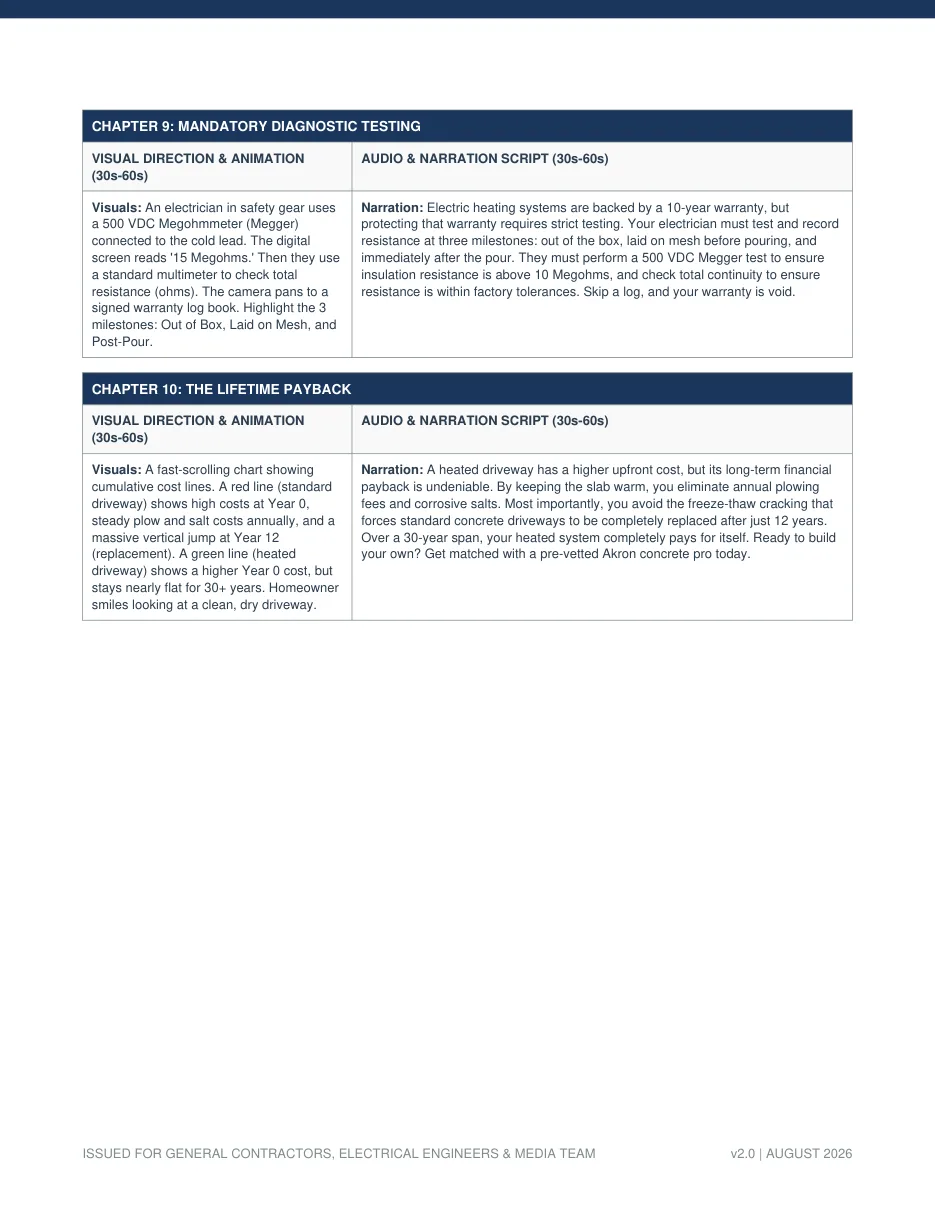
- Testing: a signed 500 VDC Megger log above 10 megohms at all three milestones.
Sources
The upfront line items ($2,362 tire-track mats, $599 controller, $1,500 electrician, $1,000 incremental paving labour, $8,000 concrete baseline, $5,461 premium), the $650 annual unheated baseline ($450 plowing, $50 salt, $150 amortised repairs), the $57.60 seasonal operating cost, the $14,613-versus-$29,000 twenty-year totals and the 20-year net saving of $14,387, the year-12 midpoint failure point in Akron and the $4,000-to-$12,000 replacement range, and the cable lifespan of 30 to 50 years all come from the Akron concrete notebook's Modern Driveway Blueprint and Concrete Quiz content blueprints. The 50 W/sq ft density, 16¢/kWh default rate, tire-track geometry, the 6-hour storm plus 3-hour after-run convention, the 10-storms-per-season default, the $6-to-$10 per sq ft broom finish rate and the $8-to-$25 per sq ft heated-installation range are from the Concrete Paving & Driveway Calculator Development Prompts behind /akron-concrete-driveways-tools-calculators/ and /tools/heated-driveway-calculator/. Per-storm and per-season costs are recomputed here from those constants; the widely quoted 2-year payback figure does not reproduce from the notebook's own numbers and is not used. The year-by-year cumulative table is arithmetic on the ledgers above, rounded to the nearest dollar.